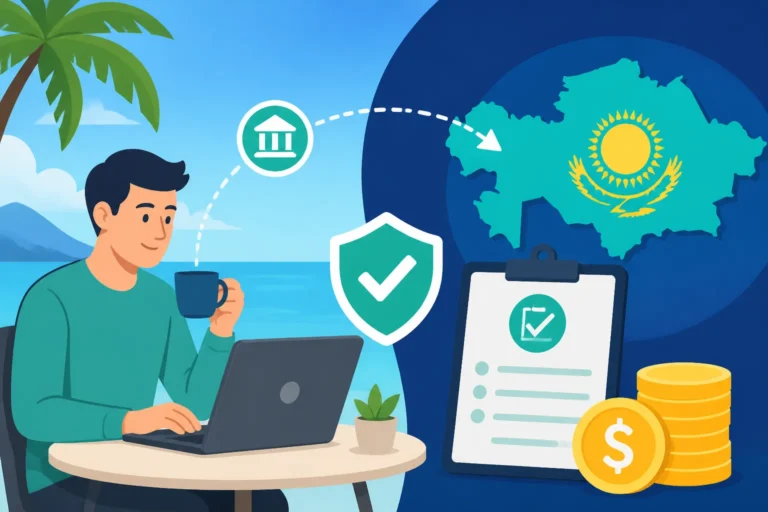
How to Pay Tax as an Individual Entrepreneur in Kazakhstan
Navigating the tax landscape as an Individual Entrepreneur (IP) in Kazakhstan can feel like an Olympic-level administrative hurdle, especially when you’re already juggling a new business in a foreign country. Many expats find themselves overwhelmed by the acronyms, the eGov portal, and the sheer volume of information that often isn’t clearly translated or simplified. This guide is here to cut through the confusion, offering a clear, empathetic roadmap on exactly how to manage your tax obligations as an IP in Kazakhstan.
Understanding What an Individual Entrepreneur Is in Kazakhstan
Before we dive into the nitty-gritty of taxes, let's clarify what it means to be an Individual Entrepreneur, or "Индивидуальный предприниматель" (IP) in Kazakhstan. Essentially, an IP is a natural person (an individual, like you or me) who carries out entrepreneurial activities without forming a legal entity, like a limited liability company (TOO). Think of it as a sole proprietorship. This is a common path for freelancers, consultants, small business owners, and those providing services who want to operate legally.
Many expats choose the IP route because it’s generally simpler and less bureaucratic than registering a company. The tax regimes are often more straightforward, and the reporting requirements are usually less demanding. However, it’s crucial to understand that as an IP, your personal assets are generally not separate from your business liabilities, which means you bear full responsibility for any business debts. This is a significant distinction from a TOO, where the company’s liabilities are separate from the owner’s personal assets. For many, the lower administrative burden outweighs this risk, especially for service-based businesses with minimal overheads.
Who Needs to Register as an IP for Tax Purposes?
This is a critical question that often catches newcomers off guard. If you’re living in Kazakhstan and actively generating income from entrepreneurial activities – whether it’s consulting, teaching English privately, selling handmade goods, or offering any kind of service – you generally need to be registered as an Individual Entrepreneur. Simply receiving money into your personal bank account for services rendered, without proper registration, could lead to issues with the tax authorities down the line. Kazakhstan, like most countries, expects you to declare and pay tax on your locally-sourced income.
The threshold for mandatory IP registration is surprisingly low. If you're consistently earning income from business activities, even if it feels small-scale at first, it's safer to register. Ignoring this can lead to penalties, fines, and retrospective tax assessments, which no one wants. This is especially true if you are a tax resident in Kazakhstan, meaning you spend 183 days or more in the country within any 12-month period. Even if you're a digital nomad or freelancer for international clients, if you are physically present and earning, local tax obligations kick in. Understanding Tax Residency Rules and the 183-Day Test in Kazakhstan is vital for any expat here.
Basic Principles of Taxation for IPs
Kazakhstan's tax system is generally considered expat-friendly, particularly with its flat 10% individual income tax rate. However, for IPs, things get a bit more nuanced because you also have to consider your chosen tax regime and social contributions. As an IP, you'll primarily be dealing with individual income tax (IIT), value-added tax (VAT) if your turnover exceeds a certain threshold, and compulsory social health insurance (OSMS) and pension contributions.
The fundamental principle is that your business income is subject to tax, but the specific rate and how it's calculated depend heavily on the tax regime you choose. This choice is usually made at the time of your IP registration and can be quite impactful on your overall tax burden and administrative effort. It's not a one-size-fits-all situation, and what works for one expat might not work for another. The State Revenue Committee (SRC) oversees all tax matters, and you'll interact with them primarily through the "Taxpayer Cabinet" on the eGov portal. It’s important to remember that tax laws can change, so staying informed is key.
Choosing Your Tax Regime as an Individual Entrepreneur
This is arguably the most crucial decision you'll make as an IP, as it dictates your tax rate, reporting frequency, and compliance burden. Kazakhstan offers several special tax regimes designed to simplify life for small and medium-sized businesses, which IPs often fall under. Making the right choice upfront can save you a lot of headaches (and money) later.
Simplified Declaration Regime
The Simplified Declaration Regime is by far the most popular choice for individual entrepreneurs in Kazakhstan, and for good reason. It lives up to its name – it truly simplifies things! Under this regime, you pay a combined tax rate of 3% on your gross income. Yes, that's right, 3% on everything you earn, without deducting expenses. This 3% is split, with half going to individual income tax (IIT) and the other half to social tax. This regime is typically available to IPs with an annual turnover not exceeding a certain limit (currently around 24,038 monthly calculation indexes, or MCI). For 2024, this translates to roughly 88.6 million KZT.
The beauty of the Simplified Regime lies in its minimal reporting. You only need to file a tax declaration twice a year, once for the first half (due by August 15th) and once for the second half (due by February 15th of the following year). Payment deadlines are August 25th and February 25th, respectively. This reduces paperwork significantly and allows you to focus on your business. Many freelancers and consultants find this regime ideal due to its simplicity and low rate. Just remember, no expenses are deductible here, so if you have very high business expenses, this might not be the most advantageous option.
Using the Patent Regime
The Patent Regime is designed for very small businesses with a predictable, low income, usually those providing services directly to the public. Think small repair shops, private tutors, or beauticians working independently. Under this regime, you purchase a "patent" for a fixed period (from one month to one year), which essentially pre-pays your tax. The tax rate is also 1% of your projected income. The income limit for the Patent Regime is significantly lower than the Simplified Regime, typically around 3,528 MCI per year, which is approximately 13 million KZT for 2024.
The main advantage of the Patent Regime is its ultimate simplicity: you buy the patent, and you're done with tax obligations for that period, provided your income stays within the declared projection. There are no regular declarations to file, assuming you stay within your limits. However, it’s not suitable for everyone. If your income fluctuates or exceeds the low threshold, you'll need to switch regimes, which can be an administrative hassle. It’s a good option for very niche, small-scale operations with highly predictable income, but most expats find themselves outgrowing it quickly or not fitting the criteria from the start.
General Established Procedure Regime
The General Established Procedure (GEP) Regime is the default option if you don't choose a special regime or if your business activities and income exceed the limits for the Simplified or Patent regimes. Under GEP, IPs pay a flat 10% individual income tax on their net income. This means you can deduct legitimate business expenses from your gross income before calculating your tax liability. This is a crucial difference: 3% on gross income vs. 10% on net income.
While the tax rate is higher, the ability to deduct expenses can make GEP more attractive for businesses with significant operational costs, like those buying equipment, paying rent for an office, or having high marketing expenditures. However, GEP comes with a higher administrative burden. You need to maintain proper accounting records, track all your income and expenses meticulously, and file an annual tax declaration (Form 220.00) by March 31st of the year following the reporting year. This means more paperwork and potentially the need for an accountant. For some larger individual enterprises or those who outgrow the simplified regime, GEP becomes necessary. Services like Taxes for Expats might be particularly useful for those on the GEP regime due to the added complexity of expense tracking and annual filings.
Here’s a quick overview of the main tax regimes for IPs:
| Feature | Simplified Declaration Regime | Patent Regime | General Established Procedure (GEP) Regime |
|---|---|---|---|
| Tax Rate | 3% on Gross Income (1.5% IIT, 1.5% Social Tax) | 1% on Projected Income | 10% on Net Income (Gross Income – Expenses) |
| Income Limit (Approx. 2024) | 88.6 million KZT/year | 13 million KZT/year | No Limit |
| Reporting Frequency | Semi-annually | None (after purchasing patent) | Annually |
| Payment Frequency | Semi-annually | Upfront (when purchasing patent) | Annually |
| Expense Deduction | No | No | Yes |
| VAT Threshold | Applies separately if turnover > 20,000 MCI | Applies separately if turnover > 20,000 MCI | Applies separately if turnover > 20,000 MCI |
| Administrative Burden | Low | Very Low | High |
| Best For | Freelancers, consultants, small service businesses | Very small, highly predictable income businesses | Businesses with high expenses or exceeding other limits |
Registering for Tax Purposes as an IP
Once you’ve decided which tax regime suits you best, the next step is to formalize your IP status and get registered with the tax authorities. This process involves a few key steps, and while it might seem daunting at first, breaking it down makes it manageable.
Obtaining Your IIN
Your Individual Identification Number (IIN) is the absolute cornerstone of all administrative and financial life in Kazakhstan. Without it, you can’t register an IP, open a bank account, pay taxes, or do pretty much anything official. If you’re already an expat living here, chances are you already have one. If not, this is your very first step. You can obtain an IIN by visiting a Public Service Centre (PSC), known locally as a "TsON" (ЦОН). You’ll need your passport and its notarized translation. The process is usually quick and often completed on the spot or within a few days. Don't underestimate the importance of this little number; it’s your key to everything. You can read more about how to get it here: How to Get an IIN (Individual Identification Number) in Kazakhstan.
Once you have your IIN, you can then proceed to register your IP. The actual registration of your IP is typically done online through the eGov portal (egov.kz). You’ll need an Electronic Digital Signature (EDS) to log in and sign documents electronically. The IP registration process itself also allows you to select your preferred tax regime. It’s crucial to select the correct regime here, as changing it later requires a separate application and can sometimes be a bit of a bureaucratic dance.
Registering with the State Revenue Committee
When you successfully register your Individual Entrepreneur status, you are automatically registered with the State Revenue Committee (SRC) – the tax authority in Kazakhstan – at your place of residence. You don't need to make a separate trip or file additional papers for this initial registration with the tax office. Your IP certificate, which confirms your registration, will be available through the eGov portal, usually within one business day. This certificate is vital, so make sure to download and keep a copy.
After IP registration, your next crucial step is accessing the Taxpayer Cabinet (cabinet.salyk.kz). This is the online portal where you’ll manage all your tax affairs: filing declarations, viewing your tax ledger, and making payments. You'll log in using your EDS. This portal can be a bit tricky to navigate at first, especially if you're working with the Russian or Kazakh versions and relying on online translation tools. Take your time, explore the sections, and don't be afraid to ask for help from local friends or a professional if something isn't clear. Familiarizing yourself with the Taxpayer Cabinet is key to smooth sailing.
VAT Registration Threshold
For most IPs, especially those just starting, VAT (Value Added Tax) registration isn't an immediate concern. However, it's something you need to keep an eye on as your business grows. In Kazakhstan, if your annual turnover exceeds a certain threshold, you become a mandatory VAT payer. Currently, this threshold is around 20,000 MCI, which translates to approximately 73.8 million KZT for 2024. If your business is growing and you anticipate exceeding this, you must apply for VAT registration.
Becoming a VAT payer means you'll need to charge VAT on your goods or services, collect it from your clients, and then remit it to the tax authorities. You'll also be able to claim back VAT on your business expenses. This adds another layer of complexity to your accounting and tax filings, requiring monthly or quarterly VAT declarations (Form 300.00). It's a significant step up in administrative burden, so monitor your income carefully. Missing the VAT registration deadline can result in substantial fines and retrospective charges, so if you're approaching this threshold, start preparing early.
Calculating and Paying Your Taxes
This is where rubber meets the road. Knowing how to actually calculate what you owe and then ensure it gets to the right place is paramount. Even with a simplified regime, there are specific steps to follow.
For Simplified Declaration IPs
If you’re operating under the Simplified Declaration Regime, your tax calculation is relatively straightforward. At the end of each half-year (January-June and July-December), you simply sum up all your gross income for that period. Then, you calculate 3% of that total. This 3% is your combined tax liability for the period. For example, if you earned 5,000,000 KZT from January to June, your tax liability would be 5,000,000 KZT * 0.03 = 150,000 KZT.
You then file your declaration (Form 910.00) through the Taxpayer Cabinet. The form itself will guide you through entering your income and calculating the exact amounts for IIT and social tax. Once filed, you'll need to make the payment by the respective deadline (August 25th for the first half, February 25th for the second half). Payments are typically made via online banking (e.g., through Kaspi.kz or Halyk Bank) or at any bank branch. You'll need the correct budget classification codes (BCCs) and payment details for the SRC, which are usually provided within the Taxpayer Cabinet or can be found on the SRC's website. It is helpful to know How Do I Pay My Income Tax in Kazakhstan.
For General Established Procedure IPs
For IPs on the General Established Procedure, calculating your tax is a bit more involved due to expense deductions. Throughout the year, you need to meticulously track all your business income and all your legitimate business expenses. This means keeping receipts, invoices, and bank statements. At the end of the year, you subtract your total allowable business expenses from your total gross business income to arrive at your net taxable income. For instance, if your gross income was 10,000,000 KZT and your deductible expenses were 3,000,000 KZT, your net taxable income would be 7,000,000 KZT. Your IIT would then be 10% of that: 7,000,000 KZT * 0.10 = 700,000 KZT.
The annual tax declaration (Form 220.00) is filed by March 31st of the year following the reporting year. This form is more comprehensive, requiring detailed breakdown of income and expenses. Due to the complexity, many GEP IPs opt to use professional accounting services to ensure accuracy and compliance. The payment deadline for the calculated tax is April 10th. Again, payments are made through banks, using the correct BCCs. It's a system that rewards diligent record-keeping, so establishing good habits from the start is paramount.
Payment Methods and Deadlines
Regardless of your tax regime, understanding the payment mechanics is crucial. Most payments to the State Revenue Committee are processed electronically. Kazakhstan's banking system, particularly with popular options like Kaspi.kz, makes this relatively easy once you have the hang of it. You’ll typically select "Tax Payments" or a similar option within your online banking app, enter your IIN, the specific budget classification code (BCC) for the tax type (e.g., income tax, social tax, pension contributions), the amount, and the payment period.
Key Deadlines for IPs on Simplified Declaration (Form 910.00):
- 1st Half (January 1 – June 30):
- Declaration Filing: By August 15th
- Tax Payment: By August 25th
- 2nd Half (July 1 – December 31):
- Declaration Filing: By February 15th of the following year
- Tax Payment: By February 25th of the following year
Key Deadlines for IPs on General Established Procedure (Form 220.00):
- Annual (January 1 – December 31):
- Declaration Filing: By March 31st of the following year
- Tax Payment: By April 10th of the following year
Missing these deadlines can lead to fines and penalties, so set reminders! If you're often dealing with international clients or income in foreign currencies, you might find services like Wise helpful for managing your finances, converting currencies efficiently, and potentially paying taxes in KZT once converted. Just ensure all your income is accurately reported in KZT according to the National Bank's exchange rate on the date of income receipt. You can also explore How to Transfer Money Into and Out of Kazakhstan as an Expat for further details.
Social and Pension Contributions
Beyond income tax, IPs in Kazakhstan are also obligated to make compulsory social and pension contributions. These are critical for your social security, access to healthcare, and future retirement benefits. Don’t overlook these; they are just as important as your income tax payments. Understanding Mandatory Social and Pension Contributions in Kazakhstan can provide a broader overview.
Mandatory Pension Contributions (MPC)
As an Individual Entrepreneur, you are required to contribute to your own pension fund. This is known as Mandatory Pension Contributions (MPC). The contribution rate is 10% of your declared income, but with a minimum and maximum limit. The minimum is 10% of the minimum wage (currently 85,000 KZT for 2024), and the maximum is 10% of 50 times the minimum wage. So, for most IPs, it's 10% of whatever income you choose to declare for pension purposes, within these limits. It is important to note that this declared income does not have to be your actual gross income; you can choose a lower, but not less than minimum wage, base for pension contributions.
These contributions are typically paid monthly. You can declare your monthly income for pension calculation purposes, and 10% of that amount will be your MPC. For instance, if you declare an income of 100,000 KZT for pension purposes, you'll pay 10,000 KZT in MPC. The payments are usually due by the 25th of the month following the reporting month. Again, separate BCCs are used for pension contributions, and these can be paid via online banking or at a bank branch.
Compulsory Social Health Insurance (OSMS)
The Compulsory Social Health Insurance (OSMS) system is Kazakhstan's public health insurance scheme, and as an IP, you are required to contribute to it to access public healthcare services. The contribution amount for IPs is fixed monthly, currently set at 1.4 times the monthly calculation index (MCI). For 2024, with MCI at 3,692 KZT, this is 1.4 * 3,692 KZT = 5,168.8 KZT per month. This amount is subject to change annually with the MCI.
Like pension contributions, OSMS contributions are also typically paid monthly, by the 25th of the month following the reporting month. Without these regular contributions, you might find yourself unable to access free or subsidized medical care at public polyclinics and hospitals. This is a common pitfall for expats who assume their private international insurance is enough, but OSMS is mandatory for residents. It’s important to understand How to Register for Compulsory Social Health Insurance (OSMS) in Kazakhstan and the implications of not paying your contributions.
Social Contributions (SC)
In addition to pension and health insurance, IPs also pay Social Contributions (SC). If you are on the Simplified Declaration Regime, your social tax portion (1.5% of gross income) effectively covers this. However, for those on the General Established Procedure, Social Contributions are calculated slightly differently. For GEP IPs, the SC is typically 3.5% of the declared income for social contributions, with a minimum base of the minimum wage and a maximum of 7 times the minimum wage.
Similar to pension and OSMS, these are paid monthly, by the 25th of the month following the reporting month. These contributions fund various social benefits, so they're another integral part of your IP obligations. Keeping these three types of contributions (Pension, OSMS, and Social Contributions) separate in your mind and ensuring all are paid on time is crucial for maintaining good standing with the Kazakhstani authorities and ensuring your access to social benefits.
Common Challenges and Best Practices for Expat IPs
Being an expat IP in Kazakhstan comes with its unique set of challenges, from language barriers to understanding cultural nuances in business. However, with some foresight and good practices, you can minimize stress and ensure compliance.
Language Barriers and Portal Navigation
The biggest hurdle for many expats is the language. While eGov and the Taxpayer Cabinet do offer English options, they are often incomplete or poorly translated. Key instructions, specific forms, or announcements might only be available in Kazakh or Russian. This can lead to misinterpretations and errors. I remember spending hours trying to figure out a specific field on a form, only to realize the English translation was completely misleading.
Best Practice: Don't hesitate to use online translation tools, but always cross-reference with a local friend, colleague, or professional who understands the system. Many smaller accounting firms in Almaty or Astana cater to expats and can help you navigate the portals for a reasonable fee. Websites like salyk.kz (the State Revenue Committee's official site) are invaluable resources, but again, be prepared for language challenges. It’s also wise to keep physical copies of any documents you submit or receive through the electronic portals, just in case.
Record Keeping and Documentation
Regardless of your tax regime, meticulous record-keeping is non-negotiable. For Simplified Declaration IPs, while you don't deduct expenses, you still need to prove your gross income. For GEP IPs, every single expense deduction needs to be backed up by a legitimate document.
Best Practice:
- Keep everything: Invoices, receipts, contracts, bank statements, payment confirmations. Digitize them if possible, and keep physical copies organized.
- Separate finances: Open a dedicated bank account for your IP business. Mixing personal and business finances is a recipe for disaster, making it almost impossible to track income and expenses accurately. Many local banks, like Kaspi Bank or Halyk Bank, offer straightforward business accounts for IPs.
- Track income in KZT: Even if you receive payments in foreign currency (e.g., USD via platforms like Wise), for tax reporting, you must convert them to Kazakhstani Tenge (KZT) using the official exchange rate of the National Bank of Kazakhstan on the date the income was received. Keep records of these conversions.
Seeking Professional Advice
While this guide aims to be comprehensive, specific situations can always arise. Changes in tax law, complex international income scenarios, or simply a lack of confidence in handling it yourself are valid reasons to seek professional help.
Best Practice: Consider consulting with an accountant or tax advisor specializing in expat taxes in Kazakhstan. They can help you:
- Confirm your optimal tax regime.
- Navigate initial registration complexities.
- Prepare and file your declarations accurately.
- Advise on international tax implications, especially if you have income from multiple countries.
- Ensure you’re maximizing any legal deductions (for GEP).
Many expats find peace of mind knowing a local expert is overseeing their tax compliance. Companies like Taxes for Expats specifically cater to individuals with cross-border tax issues, which can be invaluable if your financial situation extends beyond Kazakhstan's borders.
Staying Updated on Tax Law Changes
Kazakhstani tax laws, like those everywhere, are subject to change. MCI values, minimum wage, income thresholds, and even tax rates can be adjusted annually or periodically. Relying on outdated information can lead to non-compliance.
Best Practice:
- Follow official sources: Regularly check the
salyk.kzwebsite (or have someone check it for you). - Join expat groups: Online expat communities in Kazakhstan are often quick to share updates or discuss changes they've heard about. Just verify the information before acting on it.
- Consult your accountant: If you hire one, they will keep you informed of relevant changes affecting your IP.
Conclusion
Paying tax as an Individual Entrepreneur in Kazakhstan doesn't have to be a source of constant dread. It demands attention to detail, a bit of patience, and a willingness to learn the local administrative ropes. By understanding the basics of IP registration, carefully choosing your tax regime, meticulously tracking your finances, and fulfilling your social and pension contributions, you can build a compliant and sustainable business in this dynamic country. Remember, you're not alone in facing these challenges, and there are resources and professionals available to help you along the way. Stay informed, stay organized, and enjoy the entrepreneurial journey in Kazakhstan!
Disclaimer
The information provided in this guide is for general informational purposes only and does not constitute professional tax, legal, or financial advice. Tax laws and regulations in Kazakhstan are subject to change and may vary depending on individual circumstances. While every effort has been made to ensure the accuracy and timeliness of the information, it should not be relied upon as a substitute for professional advice. It is highly recommended that you consult with a qualified tax advisor or legal professional in Kazakhstan to address your specific situation.